Learn to connect to your body’s innate wisdom and let go of stress and tension
The Tension and Trauma Releasing Exercises (TRE for short) is a powerful and natural way to release tension and stress from within the body, helping to return us to a state of balance. With TRE, we let the body lead the way.
During TRE, a natural shaking and tremouring mechanism is activated in the body using a series of gentle stretches and exercises. This tremouring unlocks deeply held patterns of tension, bringing us out of states of fight, flight and freeze and towards a baseline of presence and connection.
What are the benefits?
The benefits of TRE can include the following:
- Becoming more grounded and resilient
- Increased awareness of body and mind
- Deeper and more restful sleep
- More focused thinking
- A sense of calm and clarity in demanding and stressful situations
- Increased energy
- Feeling safe with others
- Improved symptoms of PTSD
- Healing of old injuries
- Relief from stress related physical pain
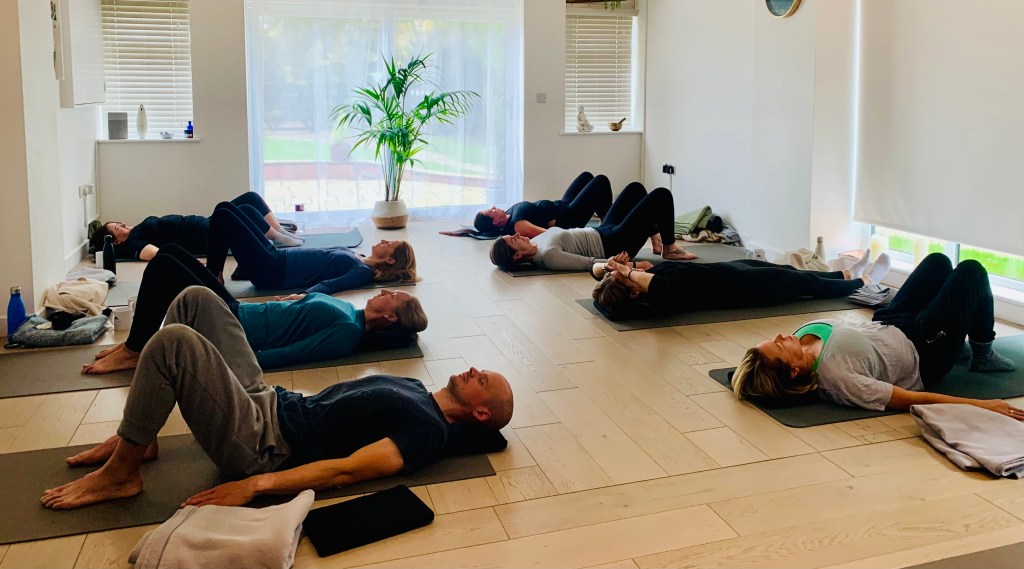
TRE Sessions with Thomas
Classes are held in-person at my studio in Chiang Mai, Thailand or online using Zoom. I can also visit your home, office, or another suitable location. I work with individuals and groups.
For those who are new to TRE, I’d recommend having four sessions to begin with so that you gain a solid foundation of understanding and experience. After that, it’s hoped that you’d be confident to practise by yourself.
During the first session I will introduce you to TRE – how it originated, how it works, and how it can help. Then I’ll carefully guide you through the process. At the end we’ll review your experience of TRE.
Follow up sessions will build upon the first. We will learn about the importance of self-regulation and how we can use specific interventions to deepen and expand the practise. We can also incorporate mindfulness, grounding and self-compassion practices which will refine our awareness of the whole process allowing for a more transformative experience.
Sessions last for between 75 – 90 minutes. Depending on your needs and wishes, sessions can include guided meditations and time for therapeutic conversation.
Please contact me to enquire about costs. Rates can be lowered if your financial situation is difficult – please state if this is the case.
“Letting go is not for the purpose of forgetting or forgiving the past, it is about releasing the energy of the past to give us back our lives in the present which is necessary to deliver us into a new future” David Berceli
Why Shake?
All mammals are familiar with shaking. It is an inbuilt faculty that allows the organism to discharge excess adrenalin and release tension.
Head to YouTube and you’ll find footage of an impala shaking after a close encounter with a leopard. When the impala realised it was in danger, its nervous system switched to the parasympathetic mode (fight/flight), flooding the muscles and tissues with adrenalin, and it ran. After being caught, the nervous system switched into the dorsal vagal response (freeze), and it played dead. Once the impala sensed that it was safe, its body began to shake. This shaking enabled the impala to discharge all of the excess adrenalin that had powered its successful escape – adrenalin that was no longer required. In essence, it deactivated its threat response. Once this process was completed, the impala’s nervous system returned to its baseline (ventral vagal), leaving it relaxed, present and at ease. It did not carry a trauma response from the episode.
The impala’s nervous system is healthy and flexible, able to smoothly transition between these three primal states of the nervous system.
Why don’t humans shake?
Actually, we do! However, as adults, we tend to view it as undesirable. We see it as a sign of weakness, of demonstrating an inability to control ourselves. Think of someone reading a speech from a piece of paper in front of dozens of people: you’ll no doubt see the paper shaking as the person stutters nervously along, desperately trying to conceal their twitching hands. But this shaking, far from being maladaptive, is actually helping to calm the person: the nervous system senses an excess of adrenalin and is attempting to discharge it. Shaking is common when we’re nervous, frightened, or have suffered some shock.
As modern day humans, our nervous systems have become out of whack. Our egos have become dominant, and helpful natural instincts, such as shaking during or after a stressful episode, have been suppressed. Consequently, we tend to not recover properly from stress and trauma, which creates patterns of tension within the body, leaving us stuck in a state of flight/flight or even freeze. Many of us carry years or even decades worth of accumulated stress and trauma in our bodies. Often, we become so used to states of anxiety on the one hand and numbness on the other that it appears to be the norm. But it’s not, and it’s quite simple to reconnect to the body’s innate wisdom, and experience presence, comfort and groundedness once again.
How did you find TRE?
I discovered TRE in 2016 while I was still a monk. I was becoming increasingly aware that tension was being held in my body, and was frustrated that I seemed unable to release it. While looking for solutions, I encountered a video of a man doing TRE. I was instantly impressed and learned how to do it myself. However, after a little experimentation, I realised I needed a guide. And so TRE was put on the shelf.
In 2020, during a period of inner transition, I realised it was time to return to TRE and sought a registered provider. It soon became a foundational tool on my own path of healing and transformation and has remained so ever since. In February 2023 I became a certified TRE Provider as I wanted to be able to share it with others.
Why do you like TRE?
I find it offers us a powerful bottom-up approach to healing and improved well-being, where we trust in the body’s own intrinsic ability to release physical and emotional tension, with results that touch all parts of our being – body and mind. Many of us are ‘top-heavy’ – allowing our minds to dominate, and often neglecting the body and its realm of feelings and emotions. But once we let the body lead the way, a whole new world of wisdom can open.
TRE also combines exceptionally well with meditation and mindfulness. If we practice meditation regularly, we’ll find our stronger mindfulness and focus enhances our experience of TRE. And vice-versa: the release of physical tension and the resulting increase of presence and groundedness that comes from TRE can allow our meditation practice to deepen.
Is TRE safe?
In most instances it’s perfectly safe. A certified TRE Provider will guide you through the process and teach you the the skills of self-regulation. You’ll learn to read the body and mind and know when to stop and when to continue.
In some instances TRE is not recommend, such as during pregnancy or if the person has severe physical injuries. If the person is suffering from severe anxiety, PTSD or clinical depression, a TRE Provider should be consulted beforehand. If you are unsure if it’s right for you, please ask.
Can I practise on my own?
Yes – that’s the idea! One of the goals as a TRE Provider is to provide you with the understanding and tools to be able to practise by yourself. It is suggested that you learn from an experienced person so that you are confident with the method and learn how to regulate and help the process along. Many people also find that the shaking process is enhanced when in the presence of another who is able to hold a safe, grounded space.
How often can I practise TRE?
For beginners, we’d recommend leaving at least 48 hrs between sessions, so two to three times per week for 15 – 20 minutes is ideal. However, once you gain more experience and familiarity with the process, you can do it every day.
More information about TRE®
David Bercelli’s YouTube channel
Recommended Reading
Accessing The Healing Power of the Vagus Nerve
 Thomas Hurst